
The Strategy
Community marketing that connects your practice with local families
Reaching local families is harder and more expensive than it used to be. Traditional advertising is crowded, online ad costs keep climbing, and every channel you can buy, your competitor can buy at the same auction on the same day. School sponsorship works differently. By supporting something a school already needs, your practice earns visibility inside the community instead of competing for attention against it.
One School. One Sponsor. Thousands of Family Impressions.
What is school sponsorship marketing?
School sponsorship marketing is a community-based strategy that lets a local business fund a resource a school needs, and in return earn visibility with the families that school serves.
The distinction that matters is the one between interrupting and supporting. Traditional advertising interrupts. It buys a slice of someone's attention while they are trying to do something else, and it works to the exact degree that it succeeds in distracting them. School sponsorship does the opposite. You are not the thing standing between a parent and what they came for. You are the reason their child's school could afford the folders, or the calendar, or the tags that make dismissal safer.
That is a different relationship, and it produces a different result. Nobody resents a sponsor. A lot of people resent an ad.
What it looks like in practice
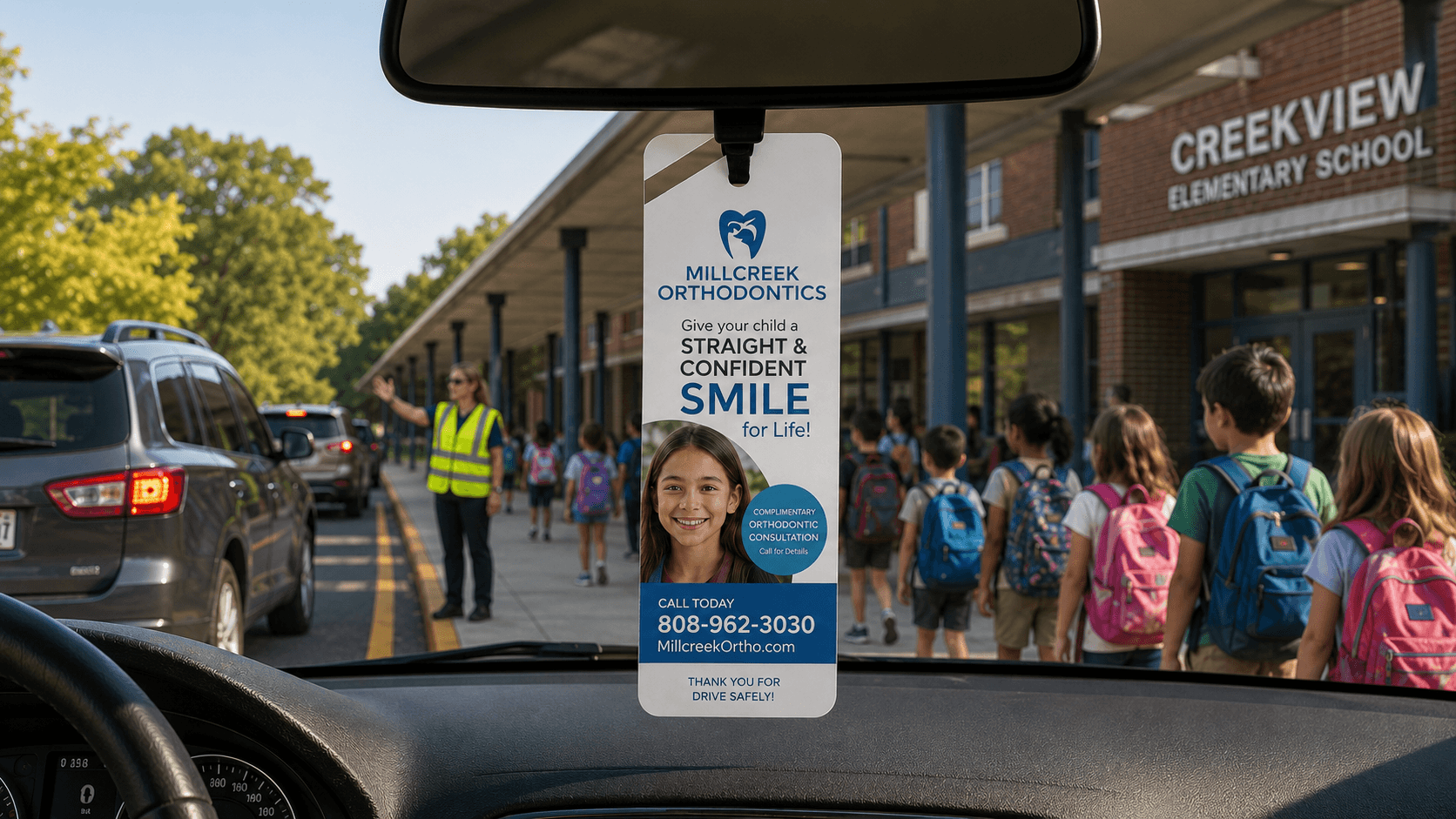
The forms are varied: Parent Pick-Up Tags, Car Rider Tags, take-home folders, school calendars, student safety programs, family engagement materials. What they share is that the school genuinely needed the item, the family genuinely uses it, and one local business made it happen.
The Problem
Why reaching families keeps getting harder
It is an auction, and everyone is bidding
The digital channels are priced by competition. The more practices in your area want the same families, the more each click costs, and the cost only moves in one direction.
It is built to be ignored
People have spent two decades learning to look past ads: the skip button, the ad blocker, the trained blindness to anything that looks like a banner.
It disappears
A digital impression exists for a second or two and then it is gone. To stay visible you have to keep paying, forever, because the moment you stop, you vanish.
Community marketing does not fix the auction. It steps outside it: not bid against anyone, not skippable because a family hung it in their own car, and not gone when the month ends because it lives in a home for a school year.
The Comparison
Traditional advertising vs. school sponsorship
Cost over time
Rises every year. You are bidding against competitors for the same family.
Set for the school year. There is no auction to win.
Attention
Skippable, scrollable, blocked by an ad blocker.
A physical object a family hung themselves. There is nothing to skip.
Lifespan
Gone in a second or two, then it is paid for again.
In the car for the entire school year, roughly 180 school days.
Competition
Every practice in your area can buy the same placement.
One sponsor per school. No competitor sits beside you.
How the family feels about it
An interruption to whatever they were doing.
Support for something their child's school actually needs.
Why schools specifically
Frequency
Schools are one of the few places families engage with all year, and not occasionally. Drop-off, pick-up, events, conferences, the folder every night. That repetition is what turns a name into a familiar name, and familiarity is most of what a local practice is actually buying.
Trust
A family's guard is down at their child's school in a way it never is in front of an ad. The school is a trusted institution, and a business that supports it borrows a little of that trust. You cannot buy that transfer on any ad platform, because it does not come from the message. It comes from the setting.
Geography
A school's families live in the school's catchment, which is the same ground your patients are drawn from. There is no wasted reach, because the geography of a school is the geography of your practice. Every impression lands on someone who could plausibly walk through your door.
The math is friendlier than it looks
The reason school sponsorship works for practices, and works less well for, say, a coffee shop, comes down to one number: what a single new patient is worth to you.
A coffee shop needs a lot of conversions to justify a marketing spend, because each new customer is worth a few dollars. A pediatric or orthodontic practice is the opposite. A single new orthodontic case, a single family that stays with your pediatric practice for years, is worth a great deal. Which means you do not need many. You need a few, sometimes one.
The break-even test
Take the value of one new patient to your practice. Divide the cost of a sponsorship by that number. The result is how many new patients you need for the sponsorship to pay for itself. For a high-value practice, that number is usually small enough to change the whole question.
An illustrative example, with round numbers you should replace with your own: if a new case is worth $5,000 to your practice, and a school sponsorship costs $1,500, you break even the moment a single family from that school becomes a patient. One. Everything after that is return, and the sponsorship is in front of those families twice a day for the rest of the year.
Those figures are illustrative, not a quote. Your case value is yours to fill in, and sponsorship pricing is set per school. The point is not the specific numbers. The point is the shape: when each customer is worth a lot and the decision is infrequent, a slow familiarity play with a low break-even is exactly the right tool.
Enter both figures to see your break-even point.
Is community marketing right for your practice?
This strategy is not for everyone, and it is worth being honest about the fit. School sponsorship works best when three things are true of your business.
Your customers are local families. If you serve a national market or you do not care where a customer lives, the geography that makes this work is wasted on you.
A customer is worth a lot. The break-even math only lands when each new patient carries real value. Orthodontics, pediatric dentistry, family dentistry, pediatrics, and other high-value family services fit. Low-margin, high-volume businesses fit less well.
The decision is slow and trust-driven. If people choose you on price in the moment, familiarity built over a school year is not your lever. If they research for months and ask other parents, it is exactly your lever.
Orthodontists, pediatric dentists, family dentists, pediatricians, and family-focused local businesses tend to check all three boxes. If that is you, the rest of this is just choosing which program.
What school sponsorship is not
We would rather tell you where this does not fit than sell you something that disappoints. Three honest limits.
It is not fast. This is a familiarity play, and familiarity takes a school year to build. If you have three empty chairs next month and you need them filled by Friday, run ads. Community marketing is how you make sure the chairs stay full a year from now, not how you fill them this week.
It is not measured by the click. You will not get a dashboard that attributes a specific new patient to a specific tag. That is the honest tradeoff for being in the physical world instead of the trackable one. What you get instead is presence, in a setting no dashboard can reach. If click-by-click attribution is the only way your practice evaluates marketing, this will frustrate you, and you should know that going in.
It is not a replacement for digital. Anyone who tells you to cancel your ads and your SEO and put it all into sponsorships is selling too hard. Keep your digital marketing. This is the thing your digital marketing cannot do: put you inside the daily routine of the exact families you want, with no competitor beside you, for a school year. It is a complement, and a strong one.
Our programs
Our primary program is Parent Pick-Up Tag sponsorships, the one families hang in the car and see twice a day. We also coordinate folders, calendars, water bottles, and other family-facing materials that carry a sponsor into the home.
Every one runs on the same idea: fund something a school needed, reach the families it serves.
See what community marketing could do near you
Tell us where you practice and we will show you which local schools are looking for a sponsor, and what it would take to be the one they find.